
Imaging solutions with Free software
and open hardware


How many bits are really needed in the image pixels?

Unfortunately the illustrations in the article got corrupted, here they are:
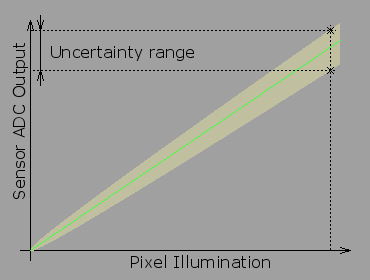


Pixel output uncertainty caused by the shot noise
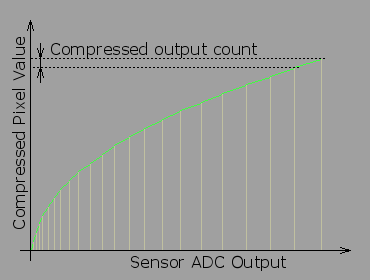


Non-linear conversion of the sensor output


The content below is downloaded from linuxdevices.com/articles/AT9913651997.html, copyright(s) of the source apply.


Click here to learn
about this Sponsor:
Home  |  News  |  Articles  |  Forum

  Home arrow Linux For Devices Articles arrow How many bits are really needed in the image pixels?

How many bits are really needed in the image pixels?
By Linux Devices

Rate This Article: Add This Article To:

How many bits are really needed in the image pixels?Modern CMOS image sensors provide high resolution digital output of 10 to 12 bits. When CCD sensors are used, the same (or higher) resolution is provided by separate ADC or integrated CCD signal processors.

This resolution is significantly higher than that used in popular image and video formats. Most are limited to only 8 bits per pixel, or 8 bits per color channel depending on the image format. To catch up with the sensor and provide higher dynamic range, many cameras switch to formats that support higher number of bits per pixels, and some of them use uncompressed, full (sensor) dynamic range raw data. Such formats use significantly more storage space, and consume more bandwidth for transmission.

Do these formats always preserve more of the information registered by the sensors? If the sensor has 12-bit digital output, does that mean that when using 8-bit JPEG, the four least significant bits are just wasted, and therefore a raw format is required to preserve them?

In most cases the answer is "no". With sensor technology advances, sensor pixels get smaller and smaller, approaching the natural limit of the light wavelength. It is now common to have pixels of less than 2x2 microns, as in the sensors used in mobile phone cameras. One consequence is reduced Full Well Capacity (FWC) -- the maximal number of electrons that each pixel can accommodate without spilling them out. This is important because of the Shot Noise -- variations of the number of electrons. (There is always an integer number of them, as there can be no electron). Shot noise is caused by the quantum nature of electric charge itself. There is no way to eliminate or reduce it for the particular pixel measurement. This noise is proportional to the square root of the total number of electrons in a pixel, so it is highest when the pixel is almost full.


Pixel output uncertainty caused by the shot noise


If we try to keep track of the pixel value in ideal conditions, with the same illumination, the same camera settings that measured pixel value will change from frame to frame. The image above shows what happens with a hypothetical sensor with an FWC of just 100. In real sensors, the uncertainty is smaller, but it can still significantly reduce the amount of received information. Our measurements show that a typical Micron/Aptina 5 Megapixel sensor MT9P031 with 2.2x2.2 micron pixels have FWC of ≈8500 electrons. As a result, when the sensor is almost full, the pixel value would fluctuate as 850092 or more than 1%. Such fluctuation corresponds to 44 counts of the 12 bit sensor ADC.

So is there any real need for such high resolution ADC when some 5-6 LSBs don't carry any real information? Yes, because modern sensors have a very low readout noise, and in the dark, a single ADC count is meaningful. The square root of zero is zero. (Actually, even in the pitch black, there are some thermal electrons that reach the pixels, even with no light at all.) With ADC counts having different information payload for small and large signals. it is possible to recode the pixel output equalizing the information values of the output counts.


Non-linear conversion of the sensor output


This non-linear conversion assigns incremental numbers to each pixel level that can be distinguished from the previous one in a single measurement, so for small signals in the dark. each next ADC output value receives the next value, increasing to more than 40 ADC counts per number for large signals. Such conversion significantly reduces the number of output values, and therefore the number of bits required to encode them, without sacrificing much of the pixel values. The form below calculates the effective number of bits for different sensor parameters and ratio of the encoder step to the noise value for that output level.


ADC resolution bits
Sensor Full Well Capacity e-
Sensor readout noise e-
Step-to-noise ratio
Number of distinct levels
Effective number of bits


Optimal encoding and gamma correction

Luckily, as described above, nothing has to be done to utilize the non-linear encoding optimal for maintaining constant noise to output count ratio. All cameras incorporate some kind of a gamma correction in the signal path. Historically it was needed to compensate for the non-linear transfer function of the electron guns used in CRT monitors. Cameras had to apply a non-linear function so the two functions applied in series (camera and display) were providing an image that was perceived to have contrast close to that of the original. With LCD displays, this is no longer required, but gamma correction (or gamma compression) also does a nice job of transferring higher dynamic range signal, even when the signal itself is converted into digital format. Different standards use slightly different values for gamma, usually in the range of 0.45-0.55 on the camera side. Compression with gamma=0.5 is exactly the same as the square root function shown above, optimal for encoding in the presence of the shot noise. With this kind of gamma encoding, a full well capacity of several hundred thousands electrons is needed to have 12 bits of meaningful data per pixel in the image file. Such high FWC values are available only in the CCD image sensors with very large pixels.

Measuring the sensor full well capacity

Earlier, I noted that our Aptina sensors have FWC≈8500e-. Such data was not provided by the manufacturer; we measured it ourselves. The FWC value is important because it influences the camera performance, so by measuring the camera performance it is possible to calculate the FWC. The same method may be applied to most other cameras, as well. First, one needs to control the ISO settings (gain) of the camera and acquire a long series of completely out of focus images. (Remove the lens if possible; if not, completely open the iris and use a uniform target.) ISO (gain) should be set to minimum, and exposure adjusted so that the area to be analyzed has a pixel level close to maximal. Use natural lighting or DC-powered lamps/LEDs to minimize flicker caused by AC power. If it is a color sensor, use green pixels only (or with incandescent lamps, red). This will provide the minimal gain. Then measure the differences between the same pairs of pixels in multiple frames. (We used 100 pairs in 100 frames.) Then find the root mean square for the differences in each pair, and divide by the square root of 2 to compensate for using differences in pairs, not the pixel values. (Pairs make this method more tolerant to fluctuation of the total light intensity and to some uncontrolled parameter changes in the camera). If it is possible to turn off gamma correction, the ratio of the pixel value to the measured root mean square of the variation will be equal to the square root of the number of electrons. If the gamma-correction cannot be controlled, one may assume it is around 0.5.


Discuss How many bits are really needed in the image pixels?
 
>>> Be the FIRST to comment on this article!


>>> More Linux For Devices Articles Articles          >>> More By Linux Devices


FUEL Database on MontaVista Linux
Whether building a mobile handset, a car navigation system, a package tracking device, or a home entertainment console, developers need capable software systems, including an operating system, development tools, and supporting libraries, to gain maximum benefit from their hardware platform and to meet aggressive time-to-market goals.

Breaking New Ground: The Evolution of Linux Clustering
With a platform comprising a complete Linux distribution, enhanced for clustering, and tailored for HPC, Penguin Computings Scyld Software provides the building blocks for organizations from enterprises to workgroups to deploy, manage, and maintain Linux clusters, regardless of their size.

Data Monitoring with NightStar LX
Unlike ordinary debuggers, NightStar LX doesnt leave you stranded in the dark. Its more than just a debugger, its a whole suite of integrated diagnostic tools designed for time-critical Linux applications to reduce test time, increase productivity and lower costs. You can debug, monitor, analyze and tune with minimal intrusion, so you see real execution behavior. And thats positively illuminating.

Virtualizing Service Provider Networks with Vyatta
This paper highlights Vyatta's unique ability to virtualize networking functions using Vyatta's secure routing software in service provider environments.

High Availability Messaging Solution Using AXIGEN, Heartbeat and DRBD
This white paper discusses a high-availability messaging solution relying on the AXIGEN Mail Server, Heartbeat and DRBD. Solution architecture and implementation, as well as benefits of using AXIGEN for this setup are all presented in detail.

Understanding the Financial Benefits of Open Source
Will open source pay off? Open source is becoming standard within enterprises, often because of cost savings. Find out how much of a financial impact it can have on your organization. Get this methodology and calculator now, compliments of JBoss.

Embedded Hardware and OS Technology Empower PC-Based Platforms
The modern embedded computer is the jack of all trades appearing in many forms.

Data Management for Real-Time Distributed Systems
This paper provides an overview of the network-centric computing model, data distribution services, and distributed data management. It then describes how the SkyBoard integration and synchronization service, coupled with an implementation of the OMGs Data Distribution Service (DDS) standard, can be used to create an efficient data distribution, storage, and retrieval system.

7 Advantages of D2D Backup
For decades, tape has been the backup medium of choice. But, now, disk-to-disk (D2D) backup is gaining in favor. Learn why you should make the move in this whitepaper.

Got a HOT tip?   please tell us!
Free weekly newsletter
Enter your email...
PLATINUM SPONSORS


ADVERTISEMENT


Check out the latest Linux powered...

Mobile phones!

MIDs, UMPCs
& tablets

Mobile devices

Other cool
gadgets

Resource Library

• Unix, Linux Uptime and Reliability Increase: Patch Management Woes Plague Windows Yankee Group survey finds IBM AIX Unix is highest in ...
• Scalable, Fault-Tolerant NAS for Oracle - The Next Generation For several years NAS has been evolving as a storage ...
• Managing Software Intellectual Property in an Open Source World This whitepaper draws on the experiences of the Black Duck ...
• Open Source Security Myths Dispelled Is it risky to trust mission-critical infrastructure to open source ...
• Bringing IT Operations Management to Open Source & Beyond Download this IDC analyst report to learn how open source ...


Most popular stories -- past 90 days:
 Linux boots in 2.97 seconds
 Tiniest Linux system, yet?
 Linux powers "cloud" gaming console
 Report: T-Mobile sells out first 1.5 million G1s
 Open set-top box ships
 E17 adapted to Linux devices, demo'd on Treo650
 Android debuts
 First ALP Linux smartphone?
 Cortex-A8 gaming handheld runs Linux
 Ubuntu announces ARM port


DesktopLinux headlines:
 Simulator runs Android apps on Ubuntu
 Hypervisor rev'd for higher reliability
 Pluggable NAS now supports Linux desktops
 Moblin v2 beta targets netbooks
 Linux-ready netbook touted as "Student rugged"
 USB display technology heading for Linux
 Ubuntu One takes baby step to the cloud
 Game over for Linux netbooks?
 Linux Foundation relaunches Linux web site
 Dell spins lower-cost netbook


Also visit our sister site:


Sign up for LinuxForDevices.com's...

news feed


Or, follow us on Twitter...